For Muslims embarking on the sacred journeys of Hajj or Umrah, preparation involves more than just booking flights and packing bags. It requires a deep understanding of the spiritual boundaries set by the Prophet Muhammad (PBUH). One of the most critical concepts to grasp before you travel is the Miqat. But what is miqat in Islam, and how does it affect your journey from the UK?
Whether you are traveling on one of the popular umrah packages uk offers or planning a bespoke itinerary, crossing the Miqat in the correct state of spiritual readiness is essential for your pilgrimage to be valid. In this article, we will explore the profound meaning of miqat in Islam, locate the geographical boundaries, and provide practical advice for British pilgrims flying to Saudi Arabia.
The Meaning of Miqat in Islam
To understand the meaning of miqat in Islam, we must consider both its literal and spiritual dimensions. Linguistically, the Arabic word “Miqat” (plural: Mawaqeet) translates to “a stated time” or “a place.” In Islamic jurisprudence (Shariah), it refers to the specific physical boundaries and stations where a pilgrim must enter the state of Ihram (the sacred state of consecration) before proceeding to Makkah to perform Hajj or Umrah.
The concept of Miqat establishes a spiritual threshold. It ensures that pilgrims do not enter the holy sanctuary of Makkah in a casual state of mind. Instead, crossing the Miqat forces a transition from the mundane world into a state of heightened devotion, humility, and equality. Before crossing this boundary, you must perform the necessary purification rituals, put on the Ihram garments, and make your formal intention (Niyyah) to perform the pilgrimage.
To ensure you comply with all spiritual requirements, it is vital to familiarise yourself with the detailed Ihram rules for Umrah before departing from the UK.
The Five Major Miqat Stations
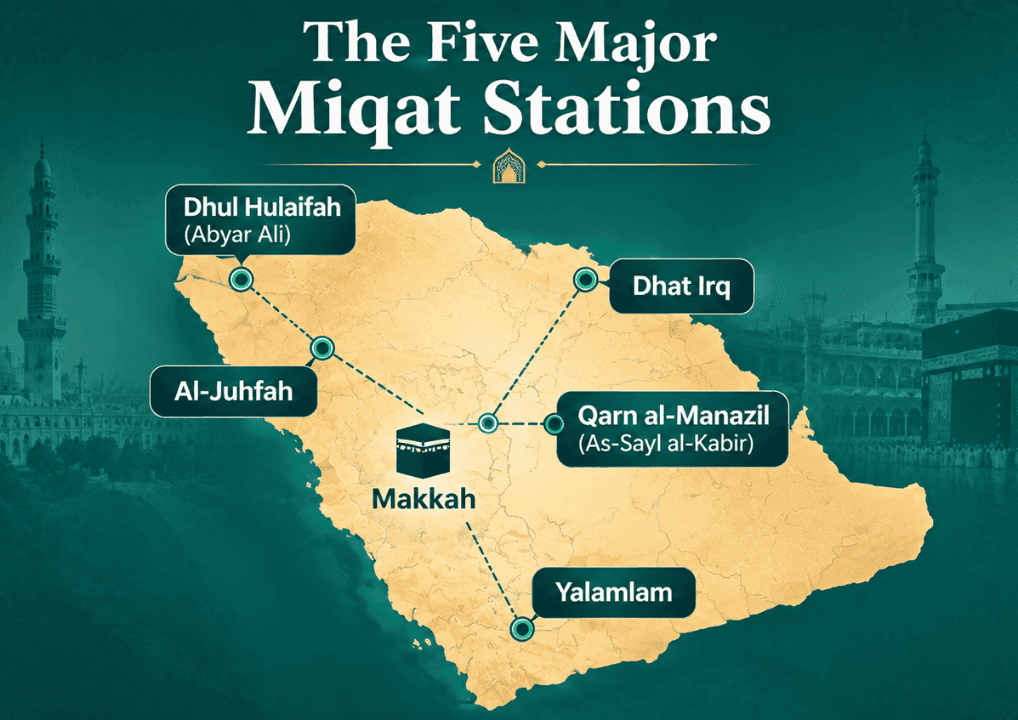
The Prophet Muhammad (PBUH) designated specific Miqat stations for pilgrims arriving from different directions of the world. Understanding these locations helps you plan when and where to change into your Ihram, especially when booking an umrah package from uk.
1. Dhul Hulaifah (Abyar Ali)
Located about 9 kilometers from Madinah and 450 kilometers from Makkah, this is the Miqat for those who live in Madinah or those who travel to Madinah first before heading to Makkah. It is the furthest Miqat from Makkah. If your UK travel itinerary includes landing in Madinah first, you will put on your Ihram here before traveling south to Makkah.
2. Al-Juhfah
Situated near Rabigh, about 182 kilometers northwest of Makkah, Al-Juhfah is the designated Miqat for pilgrims arriving from North America, Europe, Turkey, Syria, Egypt, and North Africa. For UK pilgrims flying directly to Jeddah, this is the boundary line you will cross while in the air.
3. Qarn al-Manazil (As-Sayl al-Kabir)
Located approximately 80 kilometers east of Makkah, this station serves pilgrims coming from Riyadh, the Najd region, the UAE, and other Gulf nations. It is also the Miqat for those traveling from East Asia who pass through this route.
4. Yalamlam
This Miqat in Islam is located about 92 kilometers southeast of Makkah. It historically served pilgrims arriving by sea or land from Yemen, India, Pakistan, and other regions of the southern Indian Ocean.
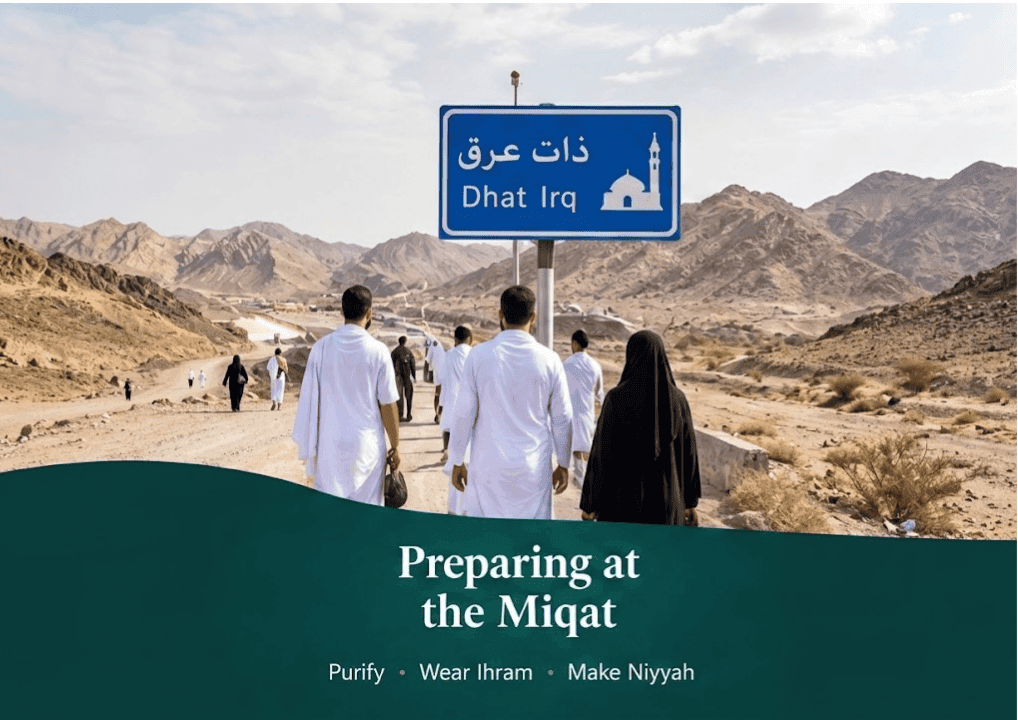
5. Dhat Irq
Situated about 90 kilometers northeast of Makkah, this is the Miqat designated for pilgrims coming from Iraq, Iran, and other countries to the northeast of Arabia.
Miqat vs Ihram: What Is the Difference?
| Term | Meaning |
|---|---|
| Miqat | The designated boundary that pilgrims must not pass when intending Hajj or Umrah without entering Ihram |
| Ihram | The sacred state a pilgrim enters through intention and Talbiyah, together with its specific rules |
| Niyyah | The intention to perform the pilgrimage |
| Talbiyah | The declaration beginning with “Labbayka Allahumma…” |
How UK Pilgrims Navigate the Miqat When Flying
For British pilgrims, the logistics of crossing the Miqat depend heavily on your flight itinerary. Most flights from London, Manchester, or Birmingham land in either Madinah or Jeddah. Here is how to handle each scenario:
Scenario A: Flying to Madinah First
If your itinerary starts with a stay in the City of the Prophet (PBUH), your journey is highly straightforward. You do not need to wear Ihram on your flight from the UK. You can wear your normal clothes, enjoy your flight, and spend your first few days in Madinah. When you are ready to travel to Makkah for Umrah, your transport will stop at Dhul Hulaifah (Abyar Ali). Here, you will perform Ghusl, put on your Ihram, pray two Rak’ahs, make your Niyyah, and begin reciting the Talbiyah.
Scenario B: Flying Directly to Jeddah
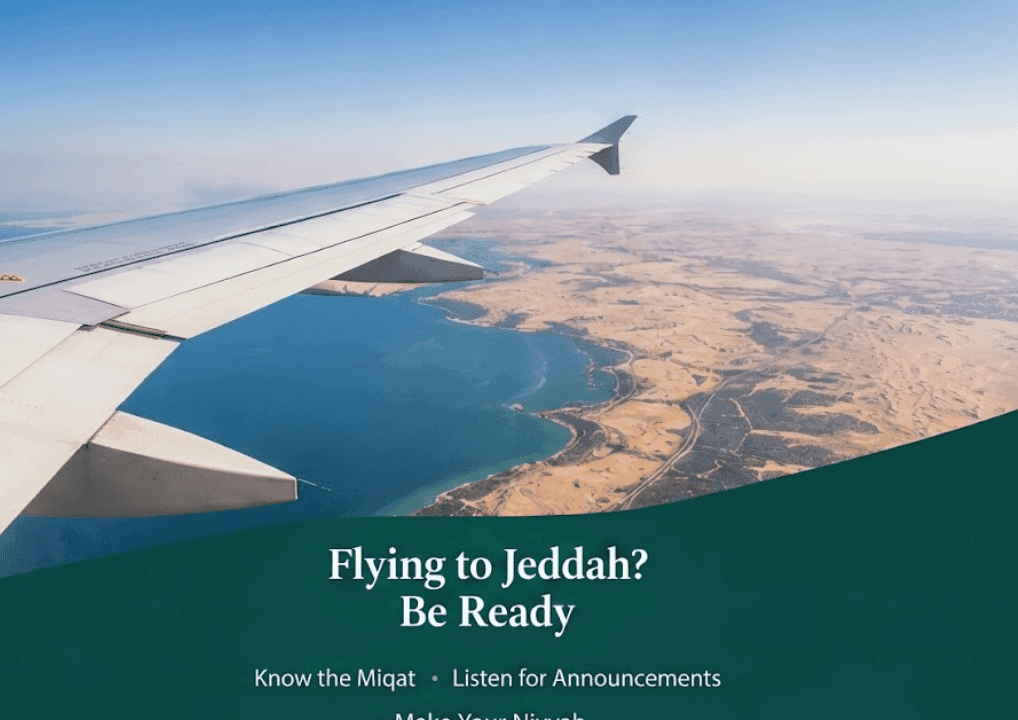
If you are flying directly to King Abdulaziz International Airport in Jeddah, you will cross the Miqat (Al-Juhfah) while in the air, approximately 30 to 45 minutes before landing. Because you cannot easily change into Ihram in a cramped airplane toilet, you must prepare beforehand:
- At the UK Airport or Home: Perform your Ghusl (spiritual bath) at home or at the airport. Put on the physical Ihram sheets (for men) or your modest Islamic dress (for women) before boarding the aircraft or during a transit layover.
- In the Air: Keep your normal intentions active, but do not make the formal Niyyah for Umrah yet.
- Crossing the Boundary: Most airlines flying to Jeddah (such as Saudia, British Airways, or Emirates) will make an announcement over the PA system when the plane is approaching the Miqat. Once the announcement is made, formally make your Niyyah (intention) and start reciting the Talbiyah.
For more practical details on managing your journey smoothly, read our comprehensive resource on how to perform Umrah.
Rules and Etiquette at the Miqat
Entering the state of Ihram at the Miqat involves several physical and spiritual steps. To ensure your pilgrimage is accepted, follow these essential practices:
- Physical Purification: Clip your nails, trim your mustache, remove unwanted hair, and perform a full bath (Ghusl) with the intention of purification.
- Scenting the Body: Men may apply perfume or attar to their head and beard, but not to the Ihram garments themselves. Once the Niyyah is made, all use of scented products must stop.
- Wearing the Ihram: Men must wear two pieces of unstitched white cloth. Women must wear modest, loose-fitting clothing that covers the entire body except for the face and hands. Female pilgrims should review the specific guidelines for performing Umrah as a woman to ensure compliance.
- The Prayer of Ihram: It is recommended to pray two Rak’ahs of Nafl prayer after putting on the Ihram, preferably reciting Surah Al-Kafirun in the first unit and Surah Al-Ikhlas in the second.
- The Intention (Niyyah) and Talbiyah: The state of Ihram only begins when you make the intention and recite the Talbiyah: “Labbayka Allahumma Umrah” (Here I am, O Allah, for Umrah).
Frequently Asked Questions About Miqat
What happens if a pilgrim crosses the Miqat without Ihram?
If a pilgrim crosses the Miqat boundary with the intention of performing Umrah or Hajj without entering the state of Ihram, they have committed a violation. To rectify this, they must either return to the Miqat station they crossed and enter Ihram properly, or perform a sacrifice (Dam)—which involves sacrificing a sheep in Makkah and distributing the meat to the poor.
Can I enter Ihram from my home in the UK?
Yes. You can physically put on the Ihram garments at your home in London, Manchester, or at the departure airport. However, do not make the formal Niyyah (intention) or start reciting the Talbiyah until you are close to the Miqat boundary in the air.
Where do residents of Makkah enter Ihram?
For those who are already inside Makkah (including tourists staying in hotels who wish to perform a second Umrah), the Miqat is the boundary of the Haram area. The most common place to enter Ihram for a subsequent Umrah is Masjid Aisha (Taneem), located about 7 kilometers from the Kaaba.
Plan Your Sacred Journey with Confidence
Understanding the spiritual boundaries of Islam ensures that your pilgrimage is performed with accuracy, peace of mind, and devotion. Navigating flight paths, airline announcements, and transit times can feel overwhelming, which is why choosing the right travel partner is so important.
At Alfajar Travel, we specialize in tailoring high-quality, reliable travel arrangements for British Muslims. From luxury packages to budget-friendly options, our team ensures every detail of your journey—from flights and hotels to visa processing—is handled professionally. Explore our range of Umrah packages today and let us help you prepare for a seamless, spiritually uplifting pilgrimage.